
My name is Eric. I work for the Scarfe Sandbox.
Learning Transformed Grant 2020-2021: Diminishing the equity gap in BEd practicum experiences
This project is made possible with generous funding from the Dean of Education via a Learning Transformed Grant (March 2020) to support the Faculty’s Strategic plan 2019 – 2024
Project Title:
Diminishing the equity gap for rural school associates, faculty advisors, and teacher candidates
Project Team:
Yvonne Dawydiak, Learning Design Manager, Teacher Education
Dr. Leyton Schnellert, Associate Professor, EDCP & Eleanor Rix Chair for Rural Education
Susanne Maguire & Heather Shippit, WKTEP, UBC T. Ed. Nelson
Dr. Marianne McTavish, Associate Dean, Teacher Education
This project seeks to develop and share online resources through an online community of practice. It is intended to build upon work by Dr. Leyton Schnellert for rural educators. Specifically, the project will work with appropriate faculty and graduate students to develop module resources to support rural (and nonrural) educators by providing all parties associated with practicum with engaging, accessible resources.
Goals:
-Provide leadership in areas of education policy and practice and in educational networks,
-Strengthen existing partnerships to enhance school-based learning experiences, placements, and
professional education and development
-Advance learning and research opportunities that are globally informed, relevant, timely,
technology-enabled, and responsive to societal needs
Project Description:
The BEd program relies heavily on the expertise of experienced teachers to mentor teacher candidates
preparing for a career in education. It can be difficult to find and retain experienced mentors who are
also abreast of current research and practice in the field and many teachers, in particular those in rural settings, do not have access to professional development opportunities to enable them to continue
learning. This can create a knowledge gap between what TCs are learning on campus and what they are
observing or being expected to do in the field. Having a shared language of teaching between faculty,
students, faculty advisors and school advisors would support rich conversations and opportunities while students are on practicum and ‘bridge the gap’ so to speak. This project seeks to develop and share online resources through an online community of practice. Specifically, this project would work with appropriate faculty and graduate students to develop a module of resources on topics relevant to rural educators including “Practical Practicum Modules”, Place & Supportive Learning Communities. By providing all parties associated with practicum with engaging, easy to access resources, we hope to help facilitate learning opportunities and open, informed dialogue.
Funding: $10,000
Initial Phases of Project Completed Fall 2020. Additional Phases pending further funding.
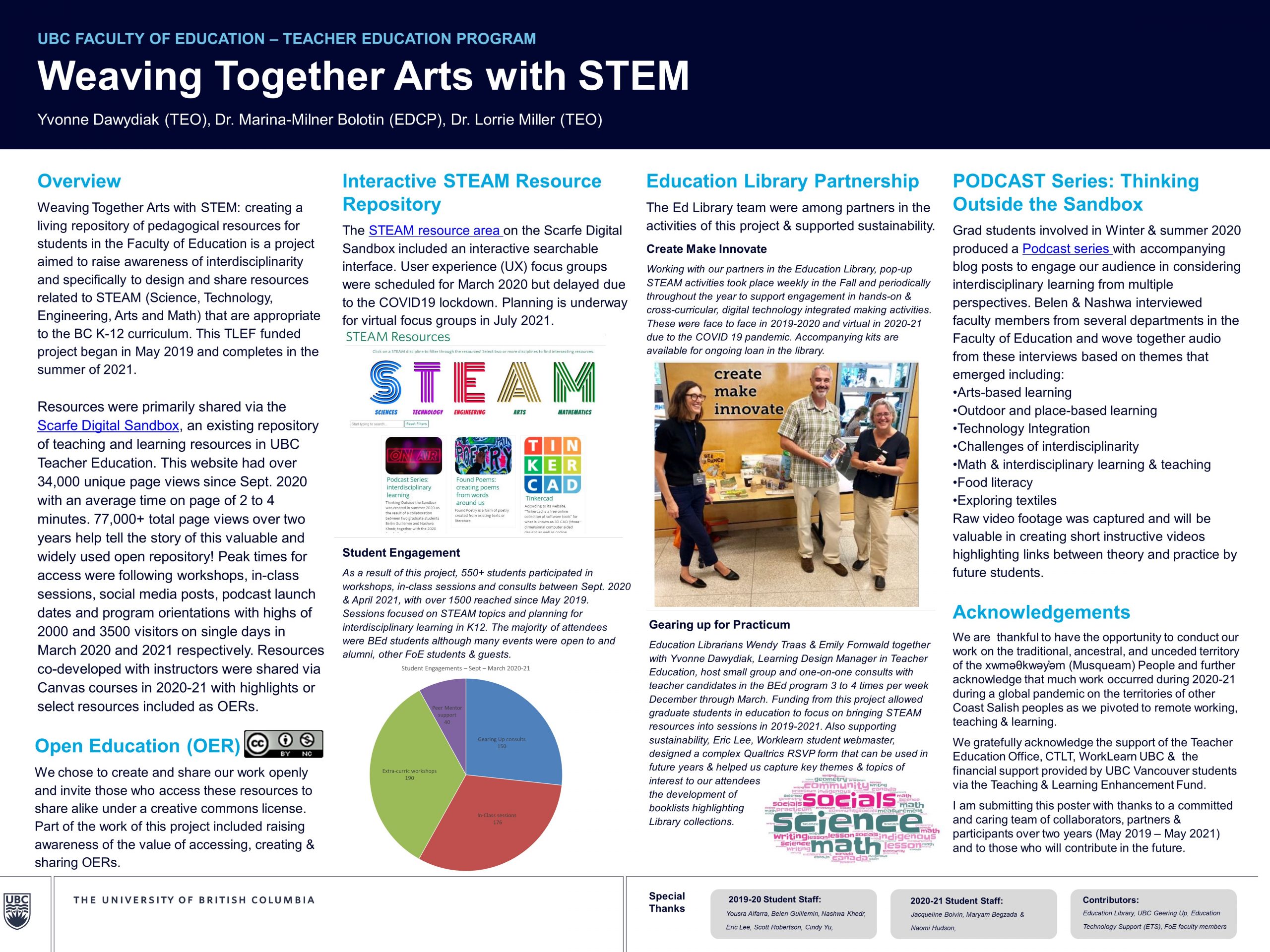
TLEF Grant 2019 – 2021: Weaving together Arts with STEM
Weaving together Arts with STEM: Creating a living repository of pedagogical resources for UBC B.Ed., Graduate and Diploma Students
Duration 2 Years
Initiation 04/01/2019
Project Summary
The BC curriculum emphasizes big ideas, inquiry, interdisciplinarity, and Indigenous ways of knowing. This unto itself poses an immense challenge to a Faculty of 700+ B.Ed., 800+ Diploma, 1100+ graduate students and thousands of alumni. In one short year, we educate teachers who will shape BC’s future. We all have the best intentions, but with our large fragmented Faculty, it is extremely challenging to integrate our courses, curricula, and pedagogies beyond a limited subset of subjects (noted within the 2018 external review). This two-year proposal addresses this challenge by creating a Faculty-wide repository consisting of interdisciplinary resources designed by students, instructors, and staff that respond to the new BC curriculum. As a common denominator, we chose science, technology, engineering, arts and mathematics (STEAM) education that crosses disciplinary boundaries and weaves the arts and the sciences in order to educate teachers who are ready to embrace the 21st century challenges.
Funding Details Small TLEF grant – Faculty of Education, UBC Vancouver
Year 1: 2019/2020
Project Partners:
Principal Investigator: Lorrie Miller, Program Coordinator / Lecturer, Teacher Education Office
Co-Investigators:
Marina Milner-Bolotin, Associate Professor, Curriculum and Pedagogy
Yvonne Dawydiak, Learning Design Manager, Teacher Education
Funded Amount $28,282
Student Team:
Eric Lee, Technological Project Assistant, Webmaster, TC Tech Coach
Scott Robertson, GAA (May-Nov 2019)
Nashwa Khadr, GAA (Jan – present 2020)
Belen Guillemin Montes, GAA (Jan – present 2020)
Year 2: 2020/2021
Principal Investigator: Yvonne Dawydiak, Learning Design Manager, Teacher Education, Faculty of Education
Co-Investigators:
Lorrie Miller, Program Coordinator / Lecturer, Teacher Education Office, Faculty of Education
Marina Milner-Bolotin, Associate Professor, Curriculum and Pedagogy, Faculty of Education
Funded Amount $21,682
We gratefully acknowledge the financial support for this project provided by UBC Vancouver students via the Teaching and Learning Enhancement Fund.
Project Outcomes
(more to come upon completion August 2021)
Taking a dip into inquiry planning & resource curation – LLED 351
Designing a cross-curricular unit plan that incorporates aspects of student inquiry is a major assignment in LLED 351, Literacy Practices and Assessment, and also excellent practice for practicum and future planning. To support you in completing this assignment, I’ve been working together with our knowledgeable education librarians and some of your instructors and to develop some resources.
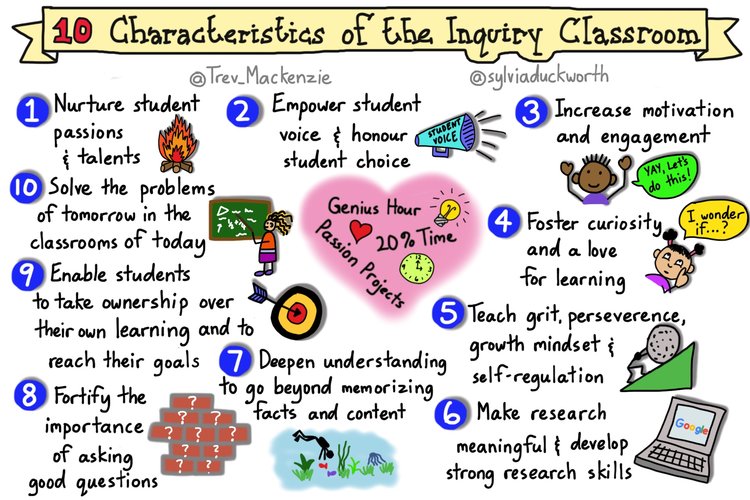
with permission from https://www.trevormackenzie.com/school-posters
When designing learning experiences to support all learners in your class, it is essential to consider your particular learners. A teacher will ask themselves a variety of questions to ensure they are planning objectives and activities to engage, support and extend learning for all learners in their classroom. Universal Design for Learning (UDL) supports this approach and recommends that teachers think ahead about all learners rather than relying solely on differentiation. This doesn’t mean that differentiation isn’t of value – it is! See this link for some strategies. What it means is that UDL will help to ensure the teacher is cognizant of planning for the success of a far wider range of students lessening the need to explicitly and individually differentiate as you teach.
Here are the slides from our in -class session to help review inquiry, planning, accessing and evaluating resources. Please don’t hesitate to be in touch and remember, Gearing up for practicum sessions are available all term to consult on planning.
UNIT PLAN EXAMPLES
You may recall we discussed how the topical research projects we often see in K-7 classrooms might involve students research specific aspects of a given topic (If animals, students may be asked to learn about the Appearance, Food, Habitat, Life Cycle, etc?; If planets, they might find out about appearance, size, density, gravity, location/position, etc; If a Country study or Ancient Civilization study, they might find out about the culture, religion, population/people, etc…). To put a more inquiry oriented ‘spin’ on this traditional practice, the teacher might provide a guiding or essential question (or the students might co-create a question) to provide a REAL purpose for gathering the information. A couple examples:
- Dinosaurs or animals – Which animal would make the best pet and why? Students learn about different dinosaurs (including appearance, food, habitat etc) in order to determine what dinosaurs needs and how they might adapt to life in our class, in our homes, in this particular habitat etc.
- Space – on which planet would you prefer to live and/or what would you need to survive? You might even incorporate ADST by designing and cardboard prototyping a tool that would support survival (thanks to one of Lisa’s students for this suggestion!)
Examples of Unit plans that incorporate elements of inquiry (remember, what these look like can vary greatly… these are simply examples!)
- Insects (Primary)
- Circle of Life (Primary)
- Communities (Primary)
- Collapse of a Society (Upper Intermediate/Middle Years)
Digital technologies we used/explored/discussed during the session:
- MindMup (free basic level of this concept mapping software allows individual maps – as a paid feature, it can integrate with google drive to allow co-creation of CMaps) Coggle is similar to Mindmup – their paid access allows co-creation and it integrates with Office 365. Most schools will have licensing for concept mapping software for the computer lab, laptop carts and/or ipads. (MindMup, Coggle, Inspiration, Kidspiration, Wrike…)
- Padlet brainstorming/co-creation – remember to moderate posts
- Interested in other SRS/assessment ideas? Visit this post related to EPSE310 In Assessment
- HERE is our padlet wall with some helpful tips for planning
Resource Evaluation and Setting Criteria:
We also did a resource evaluation activity using the “Tree Octopus”. You can find similar activity ideas to help your students develop digital literacies on MediaSmarts (Canadian developed). You can even search the resources by province, grade level, and curriculum.
As we developed criteria, it was impressive that the class was able to come up with most of those that one would use to evaluate a resource! Please remember to come up with your own 5 finger rule for evaluation (or feel free to adapt one you find – be sure to cite your sources)
- Is it verifiable using external resources? Is it reliable? How do I know?
- Authorship or sponsorship or ownership.
- Using WhoIs you can try to identify the domain owners of a particular website – can help determine ‘fake news sites’
- Check the About page
- Time, when was it published? is it dated or still relevant or current (or appropriate!)
- Authorship or sponsorship or ownership.
- Appearance, navigation, organization, accessibility – including thinking about reading level, learning differences, use of visuals, text heavy, use of text features (bolding, captions, chunking etc)
- Language use (leads to credibility and also accessibility) – is it text heavy? is it visual? Are there frequent errors in grammar etc? Does it use a lot of jargon or does it use scientific language? What is the appropriate register of language for your needs? your student needs?
5 Finger Rule for Website evaluation (for your interest/reference) – from Kathy Schrock’s guide to everything. (links to additional critical evaluation resources from Kathy’s site)
TEMPLATES for planning?
Personally, I really like the Unit Planning template designed by the Coquitlam school district. I find that the question prompts support TCs and beginning teachers in particular as they consider their students’ needs. Working with Claire Rushton, Director of the Teacher Ed Office here in Scarfe, I’ve put together an ‘in progress’ UBC blogs resource site with planning templates we’ve created or gathered, resource links and examples: Designing Learning. Should you select a template, it is important that it doesn’t simply become a task of ‘filling boxes’ – more importantly, you want to consider how the learning path or sequence of learning helps build students towards their understanding of the ‘Big Idea’ or Essential Question.
EDUCATION LIBRARY Resources
Remember this? Each school district has their own online resource center and each schools’ library catalogue can be accessed through the UBC Ed library’s Lesson Planning Pages (Elementary/Middle, Secondary). Knowing what resources you have access to at your school and district definitely supports planning for practicum!
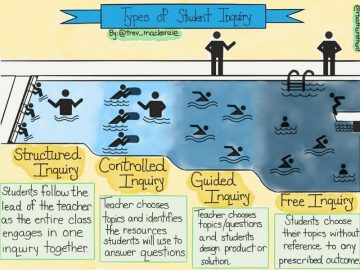
Image used with permission of @trev_mackenzie & @rbathursthunt
ADDITIONAL INFORMATION and RESOURCES:
Keep in mind as you plan that inquiry can take different forms. It does not have to look like a completely ‘free and open’ student directed process and it is important to scaffold for student success. As mentioned earlier, knowing your students is critical. I’d suggest creating a class profile (a profile of sorts is, I believe, required for your assignment) and even, at the start of practicum or beforehand, surveying each of your students individually to learn about their preferences, interests, etc. This information (in addition to knowing if they have access to a digital device they can bring to school regularly) can be of value in planning for engagement and success! Shelley Moore has done some excellent work on inclusion and has several examples of class and student profiles – Templates here: https://blogsomemoore.com/shout-outs/templates/.
The Learning for All pdf is an assessment guide from the Ontario Ministry of Ed, 2013 P.34 contains info about creating class profiles (more in-depth than needed for this course assignment, but of possible interest/use in your teaching.)
Students can create their own learner profiles – an excellent metacognitive activity that supports core competencies.
Interdisciplinary Unit Planning: Secondary Art, Sci, SS
Interweaving subjects to create an interdisciplinary Unit:
Step-by-Step
Moving beyond a fragmented and isolated approach in lesson planning towards an interdisciplinary approach to unit planning with connections to social realities, this blog post takes you step-by-step through one approach to designing an interdisciplinary unit
The approach outlined here by Nashwa Kedhr, FoE graduate student, utilizes an interesting ‘search curriculum’ tool housed on the Ministry of BC’s Curriculum website: https://curriculum.gov.bc.ca/curriculum/search. Using this tool, one can search for the big ideas, content and competencies for multiple selected subjects and grade levels in order to explore possibilities and curriculum alignment for a theme. By ‘clicking’ on ‘further elaborations’, suggested topics or questions are available.
The example (below) examines the following big ideas from Grade 10 Curriculum:
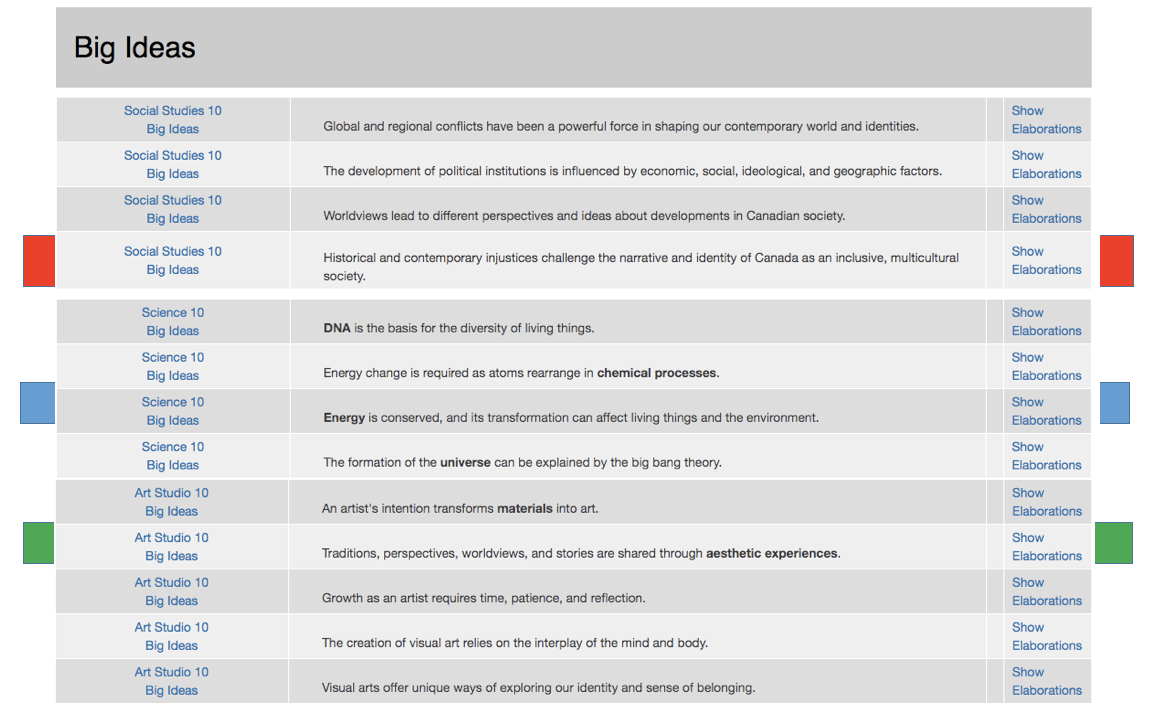
Click image to view.
By looking further into the content for the three disciplines, more clear ideas for the unit are revealed.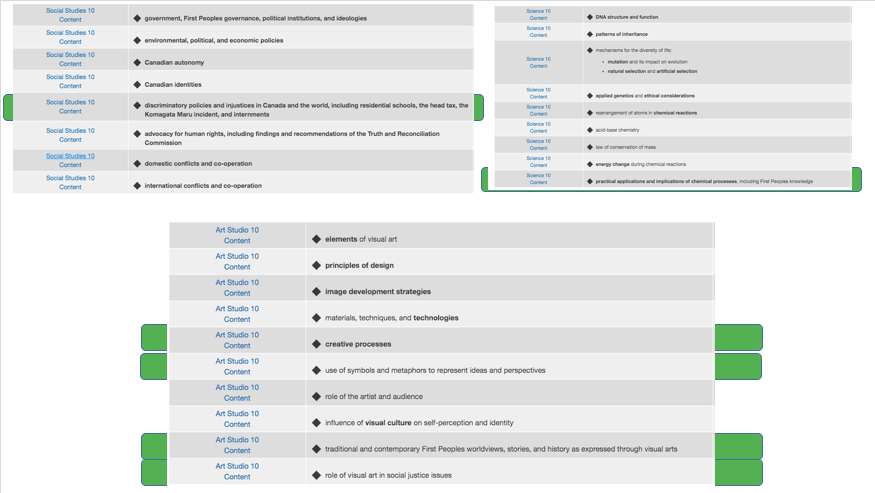
Click image to view.
Initial lesson ideas came up in relation to residential schools (social studies), First Nations applications (science) and Bentwood Box (art education). In order to design the specific lessons, the curricular competencies from the three subject areas are explored to look for skills and instructional strategies that would be suitable to plan for the content. Using the Coquitlam SD 43 School district planning template, a clear elaboration of the big ideas, content and curricular competencies are all shown in one table. Coquitlam SD 43 School district template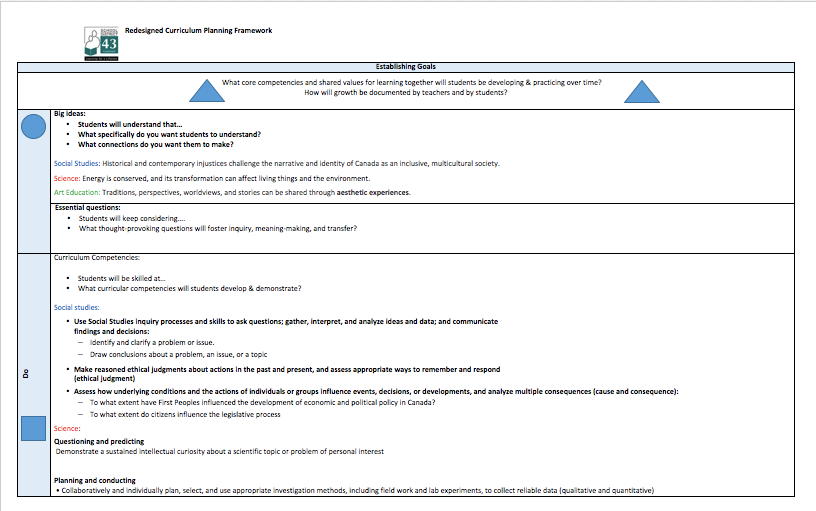
Click image to view part one of the template.
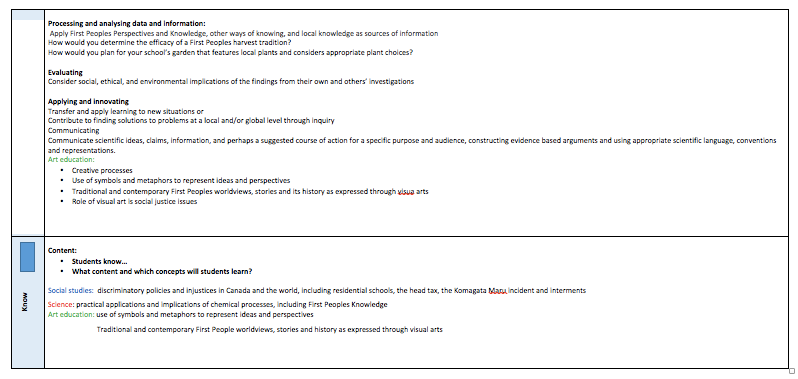
Click image to view part two of the template.
Lesson Planning
Stemming from the big ideas and curricular content, ideas for three lessons emerged.Social Studies Lesson
With a focus on stories of residential schools, students explore archival, primary source artefacts (letters and reports) and stories of different individuals involved at the time of residential schools. Students then analyze the influence of an individual’s actions in terms of resistance, agency and discrimination. Social Studies Lesson Useful resource on residential schools could be found on the Teach BC website: https://www.bctf.ca/HiddenHistory/eBook.pdfScience Lesson
In relation to depletion of natural resources, students explore the concept of harvesting in light of First Peoples knowledge and practices. Students develop experiments that compare the impact of various harvesting methods on the growth of a particular plant. Science Lesson An interesting resource on First Nations ways of harvesting is: Kimmerer, R. (2018). Mishkos Kenomagwen, the Lessons of Grass: Restoring Reciprocity with the Good Green Earth. In M. Nelson & D. Shilling (Eds.), Traditional Ecological Knowledge: Learning from Indigenous Practices for Environmental Sustainability (New Directions in Sustainability and Society, pp. 27-56). Cambridge: Cambridge University Press. doi:10.1017/9781108552998.004Art Lesson
Students explore a Bentwood box, constructed by Coast Salish artist Luke Marston that is carved from red cedar to represent First Nations, Inuit and Metis cultures. During Truth and Reconciliation Commission (TRC) events people placed personal items into the box to symbolize their journey toward healing. Students are introduced to the artist, his context and intentions. They also explore the Museum app CMHR. Finally they dissect the art piece and engage in group activities.
ArtG10
Acknowledgement: post author, Nashwa Khedr ; editor, Yvonne Dawydiak Interdisciplinarity, collaboration, hands-on learning – that’s the spirit of Create, Make, Innovate! We want to promote enthusiasm for sharing and learning across age groups and across subject disciplines.
